Start with the goal
Let people describe what they want in natural language and give them suggested prompts for common intentions.
PRODUCT DESIGN / AI-NATIVE FINTECH / 2026
A mobile banking concept that transforms “I want to save for a holiday” into a realistic savings plan — pairing conversational AI with transparent financial guidance and familiar user controls.
01 / THE PROBLEM
Banking products often require people to understand account types, navigation and financial products before they can act. In reality, people think in intentions: “Can I afford to save?” “How much can I put away?” I explored an AI-native alternative that starts with those questions.
How might we help people turn a financial intention into a clear, actionable plan without taking away their control?
02 / DESIGN PRINCIPLES
Let people describe what they want in natural language and give them suggested prompts for common intentions.
Reveal income, spending categories, what remains and why a monthly contribution is suggested.
Separate financial analysis and recommendations from user approval of a scheduled savings plan.
03 / EXPERIENCE FLOW
The scenario is simple: save €3,000 for a summer holiday, but first figure out how much is affordable each month.
Express a goal in plain language.
Review the scope of account-data use.
See spending and a recommended amount.
Verify schedule, amount and forecast.
Find the new plan among active goals.
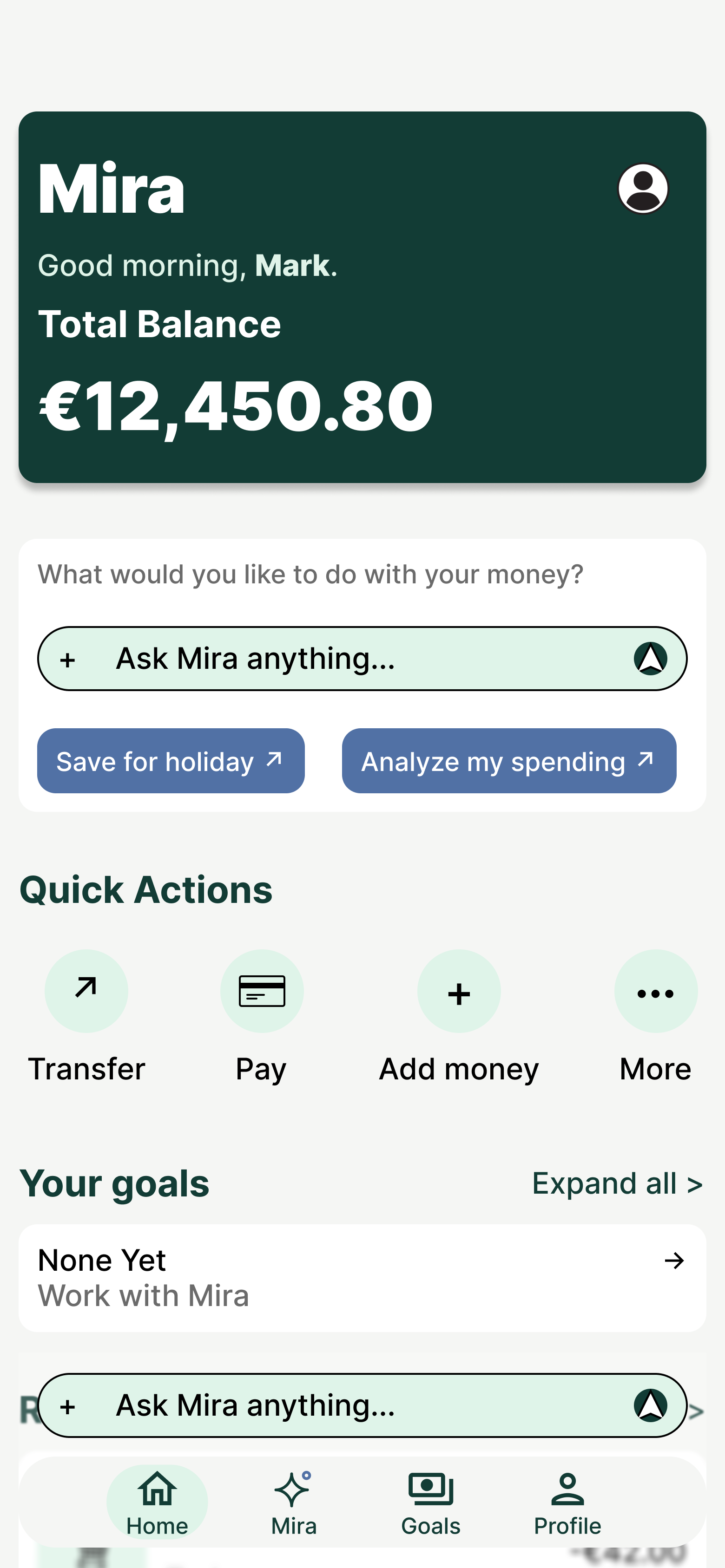
Mira keeps conventional banking actions available while introducing a persistent “Ask Mira anything” entry point. Suggested actions like “Save for holiday” help someone begin without navigating unfamiliar product categories.
Mira explicitly explains that it will review the last three months of financial activity and that this analysis will not move money or change account settings. A clear “Not now” choice makes consent meaningful.
Your financial assistant
✧ That's a great goal! I can help you work out a realistic monthly amount.
I'll use the last 3 months of account activity. This won't move any money or change your accounts.
Not now
The financial overview presents €2,450 monthly income, €1,300 essential spending and €600 other spending. This leaves €550; Mira suggests €335 a month and explains that approximately €215 remains as a buffer. Showing the math makes the suggestion easier to evaluate.
Monthly income: €2,450
Essential €1,300 Other €600
Reach €3,000 by July 2027, with a buffer of approximately €215 per month.
Based on recent spending, you have around €550 left each month.
The review page summarises the goal, contribution, first transfer, frequency and expected finish date in a familiar layout. It makes the plan inspectable before a deliberate confirmation.
‹ Back to Mira chat
Make sure everything looks right before confirming.
Goal €3,000
Monthly saving: €350
First transfer: 1 Nov 2026
Frequency: Monthly
Estimated goal: July 2027
The screens intentionally show a €335 suggested amount and €350 reviewed amount. A production-ready iteration would need to make that user adjustment explicit and editable.
The confirmation state and goals screen make the result of the conversation persistent. The €3,000 goal, €350 monthly contribution, 0% progress state and next scheduled date are visible without revisiting the chat history.
‹ Back to Mira
Goal €3,000
€350 Monthly · 0% saved
Next transfer: 1 November 2026
04 / OUTCOME
The result is a seven-screen conceptual mobile experience connecting natural-language intent, transparent financial guidance and direct user approval. This is a design exercise, not a live banking product or a measured launch.
05 / REFLECTION
This concept reinforced a principle: conversational design is useful for expressing intent, but consequential financial actions benefit from structured review, explicit permission and clear system feedback.
Next I would test whether people understand analysis versus transfer scheduling, whether the savings explanation gives appropriate confidence, and how easily they can edit the proposed contribution. No usability-testing results are claimed for this exercise.